weeks 36 to 39: scaffolding comes down

Front of house

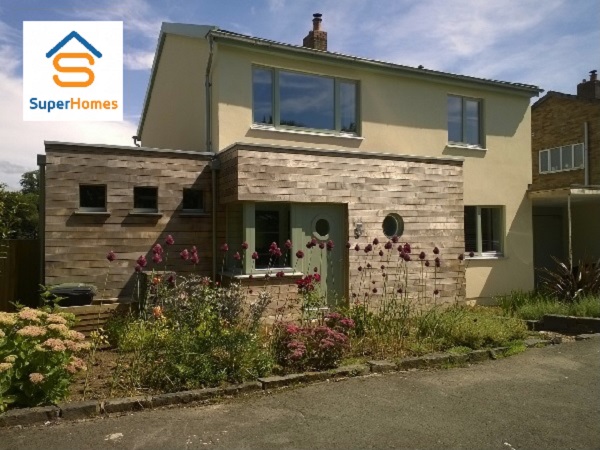
The big reveal…after an interminable wait for the scaffolding company, even to pick up the phone, they finally get them to come to take it down! But, it’s worth the wait. With the sweet chestnut cladding and steel Lindab gutters, the house looks great (completely unbiased opinion of course!). There is still a fair amount of finishing off to do: painting; render below DPC; roof profiles; sedum roof; etc., not to mention landscaping. Some of these works should be happening over the next couple of weeks.

Rear of house

The balcony is now usable. It is good and solid and almost thermal bridge free. The balustrade has been fitted: it looks okay, but not quite what we would have chosen (planning condition to match existing). Overall, though the rear of the house looks smart, and the rear extension, clad in the chestnut, smartly encloses the balcony at one end.

We haven’t quite decided on whether we should leave the chestnut to naturally silver, or whether we should lacquer it to retain the new-look colouring for as long as possible. The intention was to let it silver, but it’s nice as it is right now. I think we’re likely to leave it.

weeks 36 to 39: ventilation installation

MVHR in Pantry

We are fitting a balanced mechanical ventilation system with a heat recovery unit (MVHR). This is a ducted supply and extract system that removes moist air from wet rooms and supplies fresh air to living rooms and bedrooms. The heat energy in the extract air stream is recovered by the heat recovery unit and this is channelled into the supply air stream so that the heat energy is not lost. I evaluate many of these systems as part of my work and have found that there are frequently problems with the way the systems are designed, installed, or commissioned.. Often there are shortcomings on all three elements, – and the systems are getting bad press as a result. As we are beginning to build to increasing airtightness standards (and we are going fairly airtight here), we need a ventilation strategy that will deliver fresh air to satisfy the need for good indoor air quality. But, it is important to mitigate the resultant energy losses (extracting heated air) and use (power for fan) by employing an efficient ventilation system. If it can recover heat energy, then all the better.

I am keen to evaluate a system that has been well-designed, installed and commissioned – to monitor the system over a period of years and get some really good long-term data on the performance of an efficiently operated system. We have opted for a Paul Novus 300 unit, which is currently one of the most efficient MVHR systems on the market (94.4% heat recovery efficiency) and is certified by the Passivhaus Institut. Whilst the system can be efficient, the weak link in many systems is the ductwork that links all the outlets to the MVHR system. As the photo shows, we are using Lindab SAFE ducting, which is tubular steel ducting – not flexible plastic that many systems are. I am a firm believer that the ducting should be considered part of the long term fabric of the property – the MVHR may need replacing after, say 20 years, but I would hope to connect to the existing ducts when the time comes and not rip the house apart to replace that. The resistance in a rigid ducting system is also much, much lower, compared to flexible, meaning the system will move air much more efficiently and quietly.

MVHR isometric design drawing

The installation, designed in association with the Green Building Store, has commenced on the lower ground floor, and will need to be done in two or three phases (so more posts to follow). The MVHR unit itself is going into the existing kitchen, but we can only install this once we have moved out and into the new kitchen.

weeks 35 and 36: flooring

LGF flooring

The oak floor has now been installed on the lower ground floor. We use a local sanding specialist to both sand and oil the floor. At time of writing this post, the floor has only one coat of oil, but it looks really good. In the past I have hired floor sanders and got on with it myself, and was a bit sceptical on the advice that it should be done by a ‘professional’, but I was wrong. Knowing that the sanding company was doing the lower ground floor, I thought I would get them to do the hall on the ground floor too – a mixture of old flooring and new. The results were were astounding!

hall floor installation Hall sanding

First the hall floor was installed by the carpenters. We had the existing oak floor (made in early 1960s) re-profiled so that the extension in the hall matched. We were never sure how the old and new were going to blend in – until it was sanded…

old and new floor

The top half of the photo is the new floor, the bottom part of the photo is the existing floor – I thought it would look different, a little darker, but it is pretty much identical. It needs to be oiled next – that will be the acid test, I guess. I think I might get these guys to do the other floor boards in the house!


weeks 35 and 36: barge boards

old and new

When the rendering was done, the house looked clean and new. However, as we are keeping the existing roof, the original concrete barge caps made it all look a little drab at roof level. We came up with a solution to encapsulate the entire edge with a timber barge board that would fix into the existing concrete roof. It seems to have done the trick. The new barge boards tie-in with the new fascias for the guttering along the eaves and all of this timber edging to the roof will be painted the same colour as the windows.

bargeboard fitting


weeks 33 and 34: utility room floor

Spacetherm installed  Spacetherm

Our utility room on the lower ground floor is the only part of the original floor slab that we didn’t lower as we didn’t see the benefit of all the disruption involved with such an intervention. The disadvantage though is that we have less opportunity to insulate it to the high standard that we have for the new floor (see earlier post). We are at least able to increase the floor by a maximum of 40mm in order to meet the level of the new (higher section) floor and have specified spacetherm. This is a very thin insulation blanket, which is bonded to chipboard. We opt for 20mm thickness of spacetherm (+18mm chipboard), which gives us the make-up we need. The spacetherm is highly efficient, with an exceptionally low conductivity of 0.013 W/m.K, which impoves the U-value of the floor from the original 0.72 W/m².K down to an acceptable 0.26 W/m².K (approximately the standard required for houses built to 2010 Part L Building Regulations)

weeks 33 and 34: electrical installation

Sub-meters  Consumer units

To facilitate the future energy monitoring of the house, I asked our electrician to install sub-meters on all our circuits, e.g. lighting, general sockets, kitchen sockets, cooker, immersion, etc. These have now been installed and will be connected to the data logging equipment when that gets delivered in a few weeks time.

I also intend to connect the incoming gas and electricity meters to the logging equipment, but we need to upgrade our existing meters to modern ones with a pulsed output. Trying to explain this to the utilities companies is a bit like trying to explain the mere concept of climate change to George W. Bush. Even when I am prepared to pay for a meter upgrade, they won’t do it. I am investigating ways of doing this still (by speaking to the right meter operator), but if it comes to it I will fit my own meters on the customer side of the existing meter – seems crazy though. More on this topic will follow…

weeks 30 to 32: plastering and rendering

External base render - front

Yes, I know I’ve taken a break from updating this blog for two or three weeks, but things have been a tad busy with work, so apologies for that.

A lot has happened since the last update. Most of this has been on the internal plastering and the external rendering. Externally, the house and extension have now been rendered with two coats + mesh of Parex render base. The top coat – a through colour layer will be added next week, although the colour is only a shade different to the base layer. As we have insulation down to ground level, the render will continue below the drip profile rail, but this will be after the scaffolding has been removed. So far it looks good. The area around the front door (covered in a black wind check barrier) will be clad in sweet chestnut, which should also be added starting next week.

External base render - side

Plastering has gone really well. We have used a local plasterer, recommended by our builder, and the quality of his work and pace is quite exceptional. In the three weeks since the last blog post, he has managed to plaster the entire extension area + a bit of extra work in the existing house.

Kitchen_diner plastered Stairwell plastered

The photo above right shows the staircase now installed. This was also put in during the last three weeks and it looks great – it is a softwood stair with a curve formed for the turn at the top – the joiner has done a beautiful job, which is complemented by a curved wall, plastered to perfection.


weeks 28 and 29: more progress on external wall insulation

Fron of house EWI

The external insulation progressed well (until we ran out) and the house is beginning to be transformed. I’m sure we’re the talk of the neighbourhood – ‘what on earth are they doing?’ Weather permitting, the rendering will start next week. and it will begin to look a bit more normal.

North Front EWI

Another week, or so and the insulation should be complete on the external – a fair bit to do on internal insulation works – particularly suspended floor and loft.

weeks 28-29: staircase goes in

Stairs from bottom Stairs from top

The new staircase was installed over the last couple of weeks. We were keen to have a curve on the turn on the stairs at the top and the joiner has made a lovely job of it. As the photo top left shows, the carpenters have started to build a curved wall from the hall to wrap around the stairs. Access to our new extension at last – feels like we are getting nearer to the end of the build now!